Every new licensee asks it, and the two answers going around come with no numbers. One coach says social only. Another says website first. Here are the numbers, pulled 3 September 2026, and the order they point to.
Every new licensee asks it, and the two answers going around come with no numbers. One coach says social only. Another says website first. Here are the numbers, pulled 3 September 2026, and the order they point to.
The question, in the words people type
Search Console for this site shows three versions of the question at positions four to eight with zero clicks in the last six months: whether an immigration consultancy should run LinkedIn ads, how to market an immigration consultancy, and whether a consultant needs a website. People ask it. Nobody answers it with data. This is the answer.
What a prospect does before the call
A prospect searches, verifies the licence, reads the site and the reviews, compares the fee, then calls. Four of the five steps happen before anyone speaks to them, and three of them happen on pages the practice controls. A referral changes who they search for. It does not skip the steps. 51.9 per cent of professional services buyers rule out a referred firm before first contact, and a weak website is among the stated reasons (Hinge Research Institute, 2016, 523 buyers of professional services, not immigration clients, and still the closest measurement there is).
The search numbers
Google Keyword Planner, Canada, average monthly searches, August 2025 to July 2026.
- immigration consultant: 9,900
- immigration consultant near me: 9,900
- immigration lawyer near me: 4,400
- rcic: 3,600
- immigration consultant calgary: 1,600
- immigration consultant surrey: 1,600
- consultant en immigration: 1,300
- immigration consultant brampton: 1,000
- immigration consultant vancouver: 720
- immigration consultant toronto: 590
- immigration consultant fees: 110
- express entry consultant: 40
- spousal sponsorship consultant: 20
- how to choose an immigration consultant: 10
- study permit consultant: 0
Three things fall out of the table. "Near me" is searched as often as the generic term, so the profile a search engine shows for a near me query is not optional. The credential itself is a search term, 3,600 times a month, so the registered name, the class and the register link belong on the first screen. And nobody types the stream. A service page built for "study permit consultant" is built for zero searches a month.
Social only, the record
No study of a social-only acquisition strategy for a licensed professional was found, for or against. What exists is a vendor timeline with no published method (WebFX, April 2026): organic social takes two to four weeks to a first signal and six to nine months to sustained results, against one to two weeks for paid search and three to six months for search optimisation. A post builds the name. The name search then lands on a profile, a site and reviews, or on a third-party listing where every consultant gets the same line. Social is one channel in phase one and the compounding channel from phase two. It is never the whole plan, because it has nowhere to send anyone.
Referrals, and where they land
Referrals are the profession's default. CAPIC's own guidance for new consultants says word of mouth works, and it does. Referred clients are worth 16 per cent more over their lifetime and leave 18 per cent less often (Journal of Marketing, 2011, one bank, 9,814 customers). The register says why the default has a ceiling: 10,182 of the 11,177 licensees entitled to practise on 3 September 2026 share their company name with nobody else. There is nobody in the firm to refer from. The referral channel is worth keeping exactly as it is. It needs somewhere to land.
The order, phase by phase
- 0 Position, weeks 0 to 2: One sentence: stream, language, who it is for. The registered name, identical everywhere. The first-consultation fee, decided and credited.
- 1 The place they verify, 1 to 6: Five pages with the name, the class and the register link on the first screen. The Google profile. Three keywords: the name, consultant plus city, RCIC plus city. One social channel. A reply inside the hour. A review ask after every closed file.
- 2 Paid demand, 4 to 12: Search ads on the terms people type, one campaign per language, negatives from the search terms report. Two articles a month from the questions enquiries ask. Nurture for consultations that did not sign. A CRM.
- 3 Compounding, 9 to 18: Meta on language and community. A second-language site where the demand exists. Fifteen keywords. Conversion work on the pages that carry the load.
Phases overlap on purpose. A threshold moves a practice on, not a month.
What moves a practice to the next phase
Three numbers per phase, nine in all. Phase one watches enquiries by source, consultations booked and median reply time. Phase two watches cost per consultation booked, signed agreements a month and nurture replies. Phase three watches the share of enquiries from non-referral sources, cost per signed agreement by channel, and the pace of reviews. The thresholds for each are AFDV's working thresholds from the practices it runs, and they are printed as that. No industry benchmark exists for this profession.
What the timeline holds
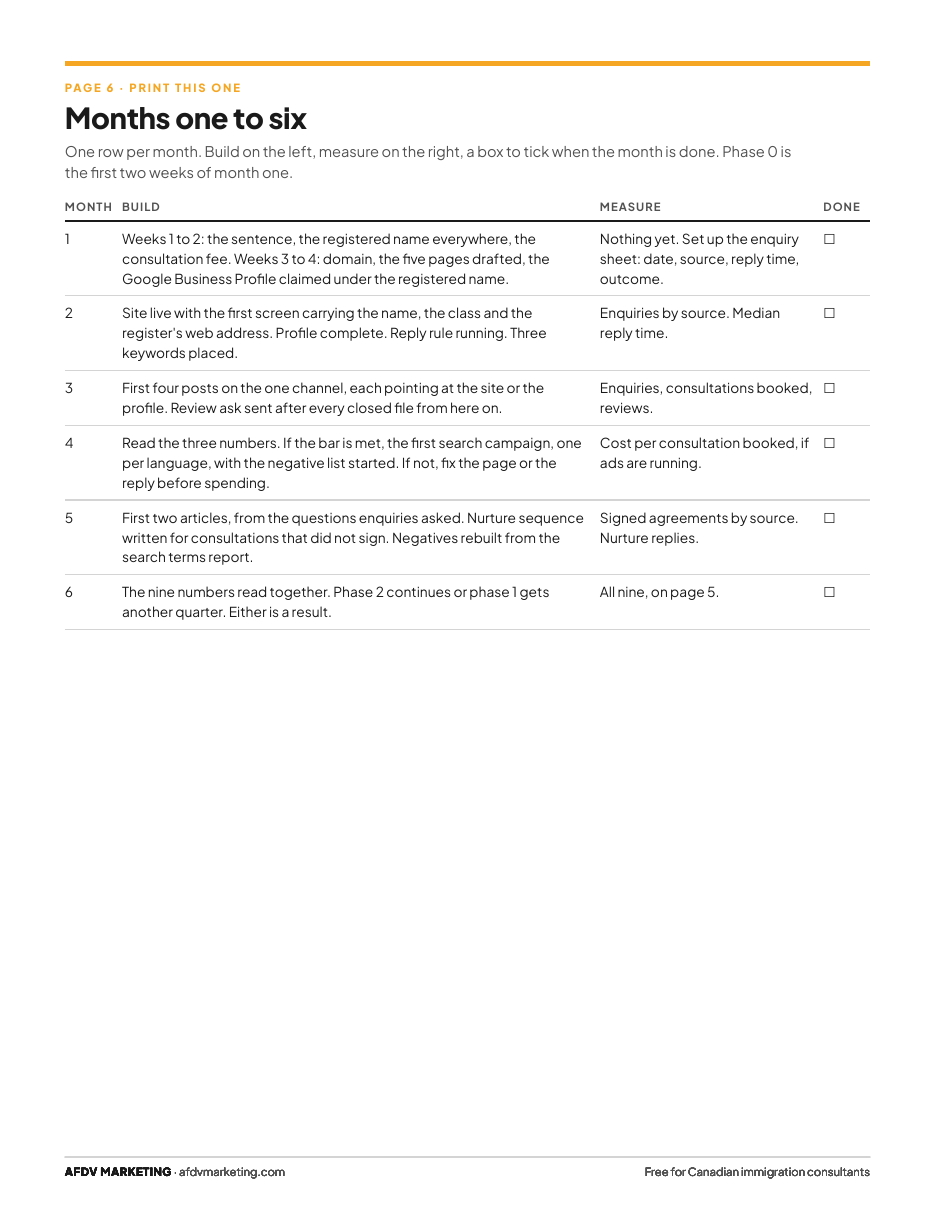
The free timeline runs seven pages: the order and the search numbers; the record on social only and referrals, with phase zero; the phase one checklist; phases two and three; the nine numbers with their thresholds; the first six months on one printable page; and what every page carries, with the hours each phase costs if one person does it alone. It is free for licensed consultants. The R number is the gate.
Sources
Google Keyword Planner, Canada, average monthly searches August 2025 to July 2026, pulled 3 September 2026. CICC public register, AFDV sweep of 3 September 2026. Hinge Research Institute, Referral Marketing, 2016, 523 buyers of professional services. Journal of Marketing, Referral Programs and Customer Value, 2011. WebFX, digital marketing timelines, April 2026. Search Console, afdvmarketing.com, 7 March to 3 September 2026.
Prefer AFDV in your Google results
Frequently Asked Questions
Yes. 51.9 per cent of professional services buyers rule out a referred firm before first contact, and a weak website is among the stated reasons (Hinge Research Institute, 2016, 523 buyers of professional services, not immigration clients). The timeline puts five pages in months one to six: home, about, services by stream, fees, book, with the registered name, the class in plain words and the register's web address on the first screen (AFDV timeline, phase 1).
No measured case of a social-only strategy for a licensed professional was found, for or against (our search, 3 September 2026). A vendor timeline with no published method puts organic social at two to four weeks to a first signal and six to nine months to sustained results, against one to two weeks for paid search (WebFX, April 2026). Social is one channel in phase one and the compounding channel from phase two.
"immigration consultant" and "immigration consultant near me" each draw 9,900 searches a month in Canada, "rcic" draws 3,600 and "consultant en immigration" 1,300 (Google Keyword Planner, Canada, August 2025 to July 2026). Stream terms barely register: "express entry consultant" 40, "spousal sponsorship consultant" 20, "study permit consultant" 0. Pages get built for the name, the credential and the city, not the stream.
Referrals work and are worth keeping: referred customers are worth 16 per cent more over their lifetime and leave 18 per cent less often (Journal of Marketing, 2011, one bank, 9,814 customers). The ceiling is structural: 10,182 of the 11,177 licensees entitled to practise share their company name with nobody else, so there is nobody in the firm to refer from (CICC public register, AFDV sweep, 3 September 2026). The referral needs a place to land.
Five published fee pages read on 3 September 2026 charge 80 to 250 dollars for 30 to 60 minutes, four of the five credit the fee against the mandate, and none headline a free first call (five published fee pages, 2026). The timeline puts the fee decision in phase zero, weeks 0 to 2: decided, and credited against the mandate.
We're not taking new clients right now
We're writing a book on growing an RCIC practice. Leave your email and get it when it's out.
Get the Book